
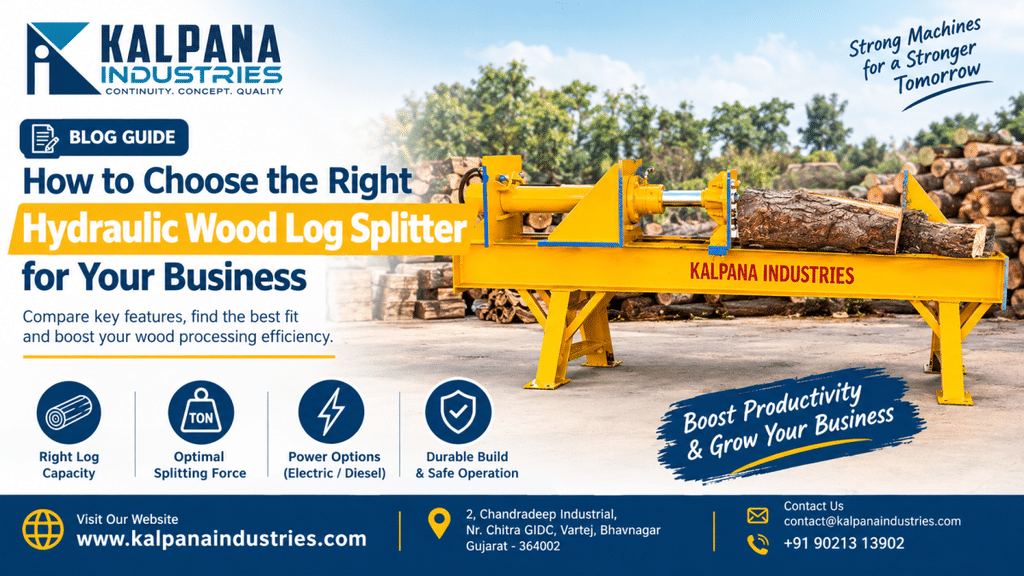
Choosing the right Hydraulic Wood Log Splitter is an important decision for businesses involved in firewood production, timber processing, forestry, and commercial wood supply. The right machine can help improve productivity, reduce manual effort, and maintain a consistent wood-splitting process.
However, different businesses have different requirements. Log dimensions, splitting force, power supply, machine construction, and daily production targets all influence the best choice.
In this guide, we explain how to select a suitable hydraulic wood log splitter for your business and what to consider before making an investment.
What Is a Hydraulic Wood Log Splitter?
A hydraulic wood log splitter is a machine that uses hydraulic pressure to push a wooden log against a splitting wedge. This force divides the log into smaller pieces for further processing or use.
Compared with traditional manual splitting methods, hydraulic machines can reduce physical effort and support more consistent production.
Businesses looking for a reliable Hydraulic Log Splitter Manufacturer should evaluate the machine’s performance, construction quality, operating requirements, and suitability for their intended application.
1. Understand Your Business Requirements
Before selecting a machine, identify the type and volume of wood you process regularly.
For example, firewood suppliers may need a machine that handles repeated splitting operations throughout the working day. Timber-processing units may prioritise larger log capacity, while smaller workshops may require a compact and practical solution.
Consider these questions before purchasing:
- How many logs do you need to split each day?
- What types of wood do you process?
- What are the average and maximum log dimensions?
- How many hours will the machine operate daily?
- Will the machine remain in one location or move between work areas?
Understanding these requirements helps you select a machine that matches your workflow and avoids paying for unnecessary capacity.
2. Check the Log Size and Splitting Capacity
Log capacity is one of the most important factors when choosing a hydraulic wood log splitter. The machine must accommodate the length and diameter of the logs you process.
A machine with insufficient capacity may not handle your regular workload efficiently. Therefore, compare the manufacturer’s stated limits with the dimensions of your actual logs.
For example, the hydraulic wood log splitter offered by Kalpana Industries is designed to handle logs up to 3 feet long and 20 inches in diameter, according to its product information.
Always confirm the specifications of the particular model before placing an order.
3. Choose the Right Splitting Force
Splitting force determines how much pressure the machine can apply to a log. The required force depends on wood type, log diameter, grain structure, knots, and moisture conditions.
A higher splitting force may be useful when processing large or difficult logs. However, selecting a machine based only on tonnage is not recommended.
Evaluate splitting force alongside log capacity, hydraulic system performance, and your expected production requirements.
Working with an experienced wood log splitter manufacturer can help you identify a suitable configuration for your business.
4. Select the Appropriate Power Source
Your available power supply and operating environment should influence your choice of machine.
Electric-Powered Hydraulic Wood Log Splitter
An electric-powered model can be suitable for workshops and production facilities with a compatible electrical connection. Consider motor requirements, phase availability, installation conditions, and operating hours.
Diesel-Powered Hydraulic Wood Log Splitter
A diesel-powered model may be appropriate for remote locations or outdoor operations where a suitable electrical supply is unavailable.
Before choosing either option, compare operating costs, maintenance requirements, fuel or electricity availability, and the conditions at your worksite.
Kalpana Industries offers power options that include a three-phase electric motor and a diesel engine. Confirm the available configuration for your intended application.
5. Compare Fixed and Movable Machine Designs
The machine’s configuration affects how easily it fits into your daily operations.
A fixed hydraulic wood log splitter may be appropriate for a dedicated production area where logs are brought to the machine.
A movable model can provide greater flexibility when splitting work takes place at different locations within a site.
Consider your available floor space, log-handling arrangements, transportation needs, and workplace layout before deciding between these options.
6. Evaluate Build Quality and Maintenance
A commercial wood-splitting machine should be suitable for the workload and working conditions in which it will operate.
When evaluating a machine, check the following components:
- Frame strength and overall construction
- Hydraulic cylinder and system quality
- Hoses, fittings, and seals
- Availability of replacement parts
- Ease of inspection and routine maintenance
- Manufacturer support and service arrangements
Regular inspection and preventive maintenance can help reduce unexpected downtime and support reliable operation.
7. Prioritise Operator Safety
Safety should be a key consideration when purchasing any industrial wood-splitting machine.
Check the availability of appropriate guards, accessible emergency-stop arrangements where applicable, safe operating controls, and clear operating instructions.
Operators should receive suitable training and use the required protective equipment. Never place hands near the splitting wedge or moving components during operation.
Follow the manufacturer’s instructions for installation, operation, inspection, and maintenance.
8. Calculate the Total Cost of Ownership
The purchase price is only one part of the investment. A business should also consider the long-term cost of operating and maintaining the machine.
Your evaluation should include:
- Initial machine cost
- Electricity or diesel consumption
- Routine maintenance expenses
- Replacement parts and servicing
- Labour requirements
- Expected production capacity
- Potential downtime and repair costs
A machine that suits your workload and operates reliably may offer better long-term value than a cheaper option that does not meet your production requirements.
Compare machines based on their suitability, operating costs, and expected output rather than price alone.
Why Choose Kalpana Industries for a Hydraulic Wood Log Splitter?
Kalpana Industries manufactures industrial equipment, including hydraulic wood log splitter machines for wood-processing applications.
The company’s product information highlights a 40-ton hydraulic jack capacity, log dimensions of up to 3 feet in length and 20 inches in diameter, fixed and movable configurations, and electric or diesel power options.
These features may suit businesses involved in firewood preparation, timber handling, and commercial wood processing, depending on their specific requirements.
If you are searching for a dependable wood log splitter manufacturer or Hydraulic Log Splitter Manufacturer, review the available specifications and discuss your operating needs before selecting a machine.
Explore the product here: Hydraulic Wood Log Splitter Machine by Kalpana Industries.
Conclusion
Choosing the right hydraulic wood log splitter requires careful consideration of log capacity, splitting force, power source, machine design, maintenance, and safety.
Start by identifying your daily production needs and the dimensions of the wood you process. Then compare available machines against your operating conditions and long-term budget.
A suitable machine can help streamline wood processing, reduce manual effort, and support more efficient business operations.
Contact Kalpana Industries to discuss your requirements and explore a suitable hydraulic wood log splitter for your business.
Contact Kalpana Industries
Address: 2, Chandradeep Industrial, Near Chitra GIDC, Vartej, Bhavnagar, Gujarat – 364002
Email: contact@kalpanaindustries.com
Phone: +91 90213 13902
Website: https://kalpanaindustries.com/