
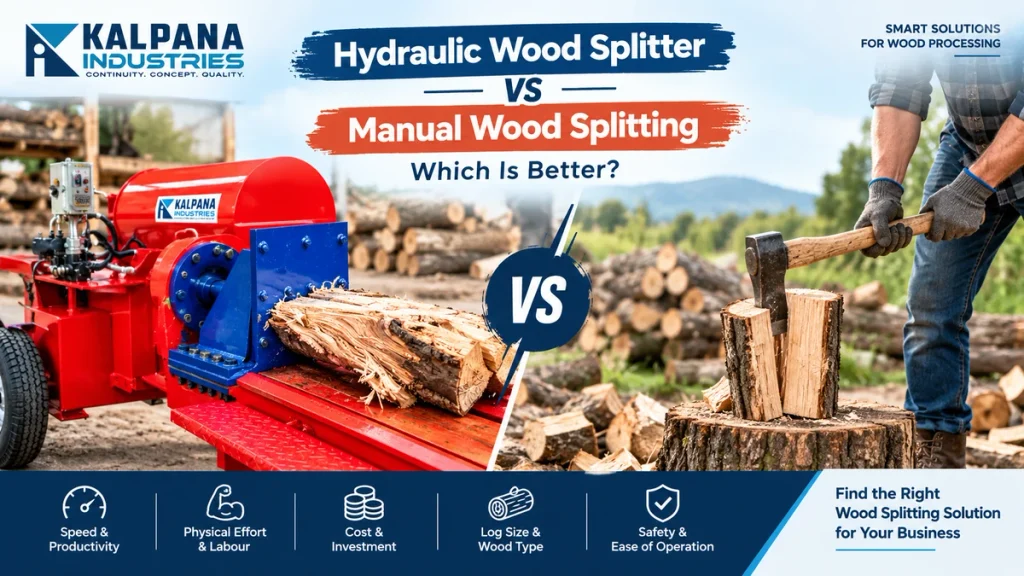
Splitting wooden logs is an essential task in firewood production, timber processing, forestry and other wood-based industries. Traditionally, workers use axes, wedges and hammers to split logs manually. However, manual wood splitting can require considerable physical effort and time, particularly when handling large or hard logs.
A hydraulic wood splitter offers a more efficient alternative by using hydraulic force to split logs with less physical effort. But is a hydraulic machine always better than manual wood splitting? The answer depends on your workload, production requirements, available budget and operating conditions.
In this guide, we compare hydraulic and manual wood splitting to help you choose the right solution for your needs.
What Is a Hydraulic Wood Splitter?
A hydraulic wood splitter is a machine that uses hydraulic pressure to push a wooden log against a splitting wedge. This controlled force helps divide logs into smaller pieces for firewood preparation and other wood-processing applications.
A modern hydraulic wood splitter machine is particularly useful for businesses that handle large logs or process wood regularly. Depending on the model, machines may offer different splitting capacities, power sources and configurations.
Kalpana Industries manufactures hydraulic wood log splitter machines designed for demanding wood-processing requirements. Explore our Hydraulic Wood Log Splitter Machine to learn more about available machine features and options.
What Is Manual Wood Splitting?
Manual wood splitting involves using tools such as axes, splitting mauls and wedges to divide logs. The operator applies physical force to split the wood into smaller pieces.
This method can be practical for occasional household use, small quantities of firewood and situations where purchasing machinery is not economical. However, splitting large volumes manually can become tiring and time-consuming.
The effectiveness of manual splitting depends on the operator’s skill, the type of wood, log dimensions and the condition of the tools.
Hydraulic Wood Splitter vs Manual Wood Splitting: Key Differences
1. Speed and Productivity
Manual splitting may be sufficient when only a few logs need processing. However, productivity can decrease when workers must split a large quantity of wood every day.
A hydraulic wood splitter can streamline repetitive splitting operations by applying controlled mechanical force. This can help businesses process more logs in less time, depending on the machine model and working conditions.
Winner for regular, high-volume work: Hydraulic wood splitter.
2. Physical Effort and Labour
Manual wood splitting requires repeated lifting, swinging and striking. These activities can cause fatigue, especially during long working hours.
A hydraulic wood splitting machine reduces the need for repeated manual striking. Operators must still load logs, position material correctly and follow operating procedures, but the machine performs the main splitting action.
Winner for reducing physical effort: Hydraulic wood splitter.
3. Initial Cost and Long-Term Value
Manual tools generally cost less initially and may be sufficient for occasional use. They do not require a powered hydraulic system.
A hydraulic machine requires a larger initial investment, along with suitable power, maintenance and operating arrangements. However, businesses processing substantial quantities of wood should evaluate the potential savings in labour time and improved productivity.
The most economical option depends on workload, machine utilisation, energy costs, maintenance and the price of labour.
Winner for low initial investment: Manual splitting.
4. Log Size and Wood Type
Small logs and suitable wood species can often be split manually. Larger, knotty or dense logs may require greater effort and specialised techniques.
A hydraulic wood log splitter can provide greater mechanical force for demanding applications. However, the maximum log length, diameter and splitting capacity depend on the specific model and the type of wood being processed.
Always check the manufacturer’s specifications before selecting a machine.
5. Consistency of Work
Manual splitting results can vary with operator skill, fatigue and the structure of the wood.
A properly selected hydraulic wood splitter can provide a more repeatable process. Actual results still depend on log condition, grain direction, machine capacity and operator technique.
For commercial wood processing, consistent operation can help improve workflow and simplify production planning.
6. Safety and Ease of Operation
Manual splitting involves sharp tools, swinging movements and the risk of flying wood fragments. Hydraulic machinery introduces different hazards, including crushing points, moving components and high-pressure hydraulic systems.
Neither method is risk-free. Use appropriate protective equipment, secure logs correctly, follow the manufacturer’s instructions and never bypass machine guards or safety controls.
A hydraulic machine should only be operated by trained personnel.
Hydraulic Wood Splitter vs Manual Splitting: Comparison Table
| Factor | Hydraulic Wood Splitter | Manual Wood Splitting |
|---|---|---|
| Initial investment | Higher | Lower |
| Physical effort | Generally lower | Generally higher |
| Bulk processing | Better suited | More labour-intensive |
| Power requirement | Depends on model | No powered machine required |
| Maintenance | Hydraulic and mechanical maintenance | Tool inspection and sharpening |
| Large-log handling | Depends on rated capacity | Can be difficult |
| Best use | Regular commercial operations | Occasional, small-scale use |
Why Choose a Hydraulic Wood Splitter Machine?
For businesses that regularly process wooden logs, a hydraulic machine can offer several operational advantages.
- Improved productivity: Helps streamline repetitive log-splitting tasks.
- Reduced physical strain: Uses mechanical force instead of repeated manual striking.
- Commercial applications: Suitable for appropriate firewood, timber and wood-processing operations.
- Power options: Selected models may be available with electric motor or diesel engine configurations.
- Flexible installation: Fixed and movable configurations can suit different working environments, depending on the model.
Kalpana Industries offers hydraulic wood log splitter machines with model-specific configurations. Review the machine specifications and available options before making a purchasing decision.
How to Choose the Right Wood Splitting Machine
Before buying a wood splitting machine, consider the following factors:
- Daily workload: Estimate the number of logs you need to process.
- Log dimensions: Check the maximum length and diameter of your logs.
- Wood type: Consider the hardness, knots and grain structure of the material.
- Power availability: Choose a compatible electric or diesel-powered configuration.
- Workspace: Determine whether a fixed or movable machine is more suitable.
- Maintenance and safety: Review maintenance requirements, operator training and safety features.
- Budget and operating costs: Compare purchase price, energy use, labour requirements and expected utilisation.
Choosing equipment based on your actual workload helps you avoid investing in a machine that is either unsuitable or unnecessarily large for your requirements.
Why Consider Kalpana Industries?
Kalpana Industries manufactures industrial equipment, including hydraulic wood log splitter machines. The available machine range includes fixed and movable configurations and selected electric motor or diesel engine options.
Businesses evaluating a hydraulic wood splitter should compare the available specifications with their log dimensions, expected workload and working conditions.
Visit our Hydraulic Wood Log Splitter Machine product page to review product details and contact our team about your requirements.
Frequently Asked Questions
Is a hydraulic wood splitter better than manual wood splitting?
A hydraulic wood splitter is generally more suitable for frequent, high-volume wood processing because it reduces physical effort and can improve productivity. Manual splitting may be more economical for occasional, small-scale tasks.
Can a hydraulic wood splitter handle large logs?
It depends on the machine’s rated capacity, maximum log dimensions, splitting force and wood characteristics. Always verify the specifications of the selected model.
Is a hydraulic wood splitter suitable for commercial use?
Yes, appropriately rated hydraulic wood splitters can be used for commercial firewood production and other wood-processing applications.
Does a hydraulic wood splitter require electricity?
Not every model does. Depending on the configuration, hydraulic wood splitters may use an electric motor or a diesel engine. Confirm the power requirements before purchasing.
How do I choose the right hydraulic wood splitting machine?
Consider log size, wood type, daily production volume, power availability, workspace, maintenance requirements and budget before selecting a model.
Conclusion
The choice between a hydraulic wood splitter and manual wood splitting depends on the quantity of wood you process and the resources available to you. Manual splitting can be suitable for occasional tasks and smaller workloads, while hydraulic machinery is often a more practical option for regular commercial operations.
If your business needs a reliable solution for repetitive or heavy-duty log splitting, explore the hydraulic wood log splitter machines offered by Kalpana Industries.
Contact Kalpana Industries
Address: 2, Chandradeep Industrial, Near Chitra GIDC, Vartej, Bhavnagar, Gujarat – 364002
Phone: +91 90213 13902
Email: contact@kalpanaindustries.com
Website: https://kalpanaindustries.com/